Colorimetry Monograph · Inorganic Pigments
Iron Oxide Undertones & CIE Lab Sebum Oxidation Shift
Complexion cosmetics rely almost exclusively on four inorganic mineral oxides plus titanium dioxide. Understanding how each crystal polymorph absorbs blue and green light reveals why shade names rarely correspond across brands.
Optical assay reference: Kubelka-Munk scattering-to-absorption ratio across milled pigment pastes.
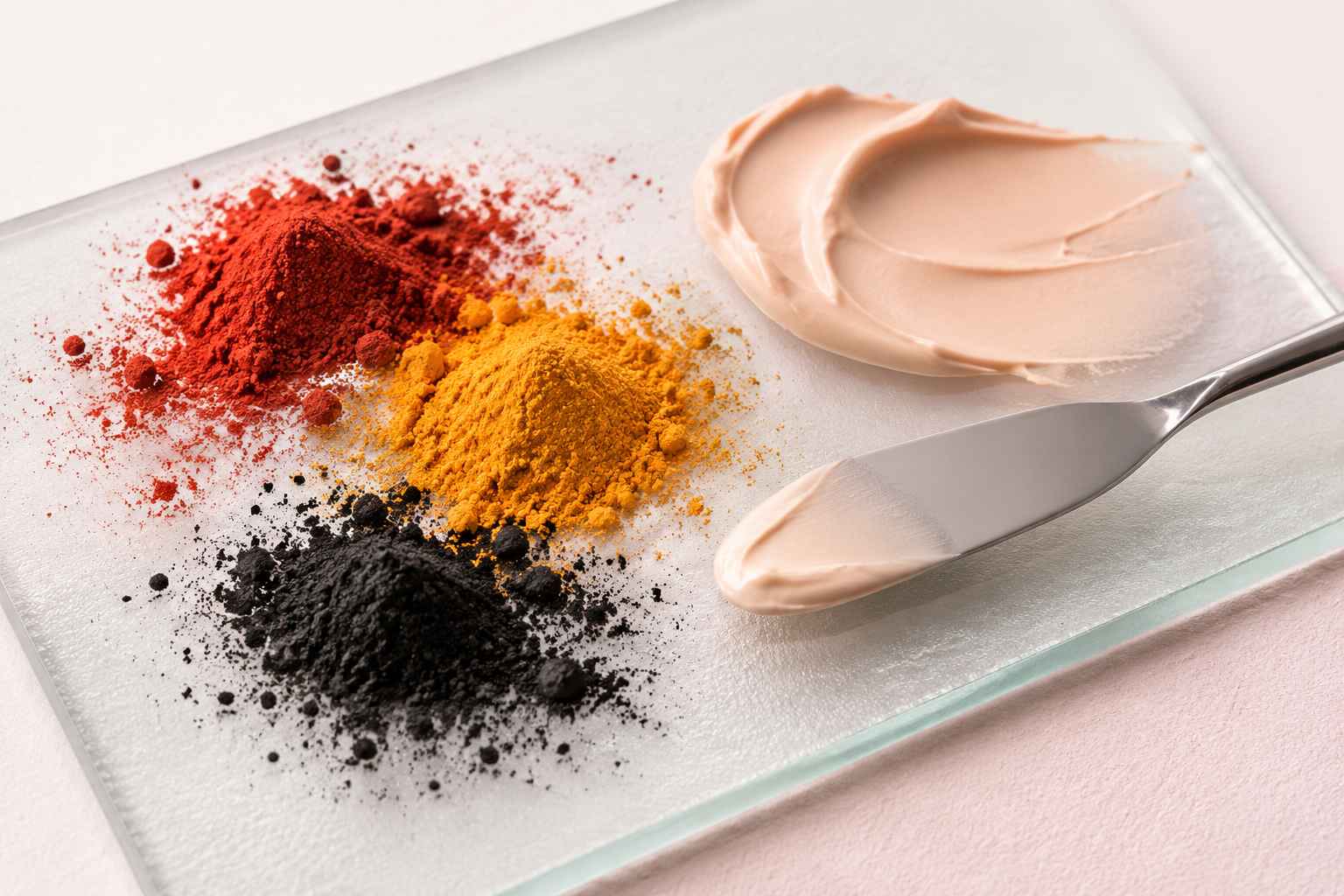
1. Pigment Stoichiometry Across Undertone Axes
Cosmetic formulators calibrate human skin reflectance in CIE L*a*b* space, where L* tracks lightness (0 black to 100 white), +a* tracks redness, -a* tracks greenness, and +b* tracks yellowness. Every foundation shade starts with a white titanium dioxide (CI 77891, refractive index 2.61) opacifying base tinted by controlled ratios of red, yellow, and black iron oxides.
| Color Index & Chemical Form | Primary Hue Axis | Cool Rose Blend | Warm Golden Blend | True Olive Blend |
|---|---|---|---|---|
| CI 77891 (Titanium Dioxide) | Luminance L* Opacifier | 64% - 68% | 50% - 56% | 54% - 58% |
| CI 77492 (Yellow Goethite) | +b* Warm Ochre | 15% - 19% | 30% - 36% | 27% - 31% |
| CI 77491 (Red Hematite) | +a* Rosy Terracotta | 12% - 15% | 8% - 11% | 5% - 7% |
| CI 77499 (Black Magnetite) | Value Depth (-L*) | 3% - 5% | 3% - 5% | 5% - 7% |
| CI 77288 / CI 77007 | -a* Olive / Blue Neutralizer | 0% | 0% | 2% - 4% |
2. Sebum Wetting & Surface Coating Stabilization
Uncoated iron oxides carry hydrophilic surface hydroxyl groups that bind poorly to silicone carriers. When facial sebum (squalene, wax esters, and oleic acid) migrates into the film after two hours, the interstitial medium shifts from air (n = 1.00) to lipid (n = 1.46). Titanium dioxide loses backscatter efficiency faster than iron oxide loses absorption, causing a net visual darkening toward orange-peach.
Silane-treated pigments (Triethoxycaprylylsilane or Isopropyl Titanium Triisostearate) wrap each crystal in a hydrophobic monolayer. In 6-hour oleic acid bench trials, silane-coated blends exhibit a median delta-E2000 drift of 1.3 units compared to 3.8 units for untreated mineral pastes.
3. Complementary Color Correcting & Strobing Light Mechanics
Neutralizing post-inflammatory erythema or under-eye blue-violet shadowing relies on additive subtraction before foundation deposition. Mint green correctors (CI 77288) cancel +a* vascular redness, whereas peach-apricot blends (CI 77491 + CI 77492) shift dark blue-slate infraorbital shadows (+b* compensation) without graying.
Test your specific pigment proportions interactively in the Undertone & SPF Compatibility Lab or review particle scattering curves in Mineral Particle Size & Mie Optics.
4. Surface Coatings: Uncoated Mineral vs Triethoxycaprylylsilane
Raw iron oxide crystals carry surface hydroxyl groups that attract polar water molecules and hydrophilic skin exudates. When suspended directly in simple oil-in-water creams or pressed powders without hydrophobic surface treatment, those polar particles cluster into microscopic aggregates during emulsion evaporation. Once skin temperature warms surface sebum and squalene, lipid droplets rapidly wick into the porous oxide clusters, reducing diffuse white-light scatter and amplifying chromatic saturation along both the red (+a*) and yellow (+b*) axes.
Modern prestige and clinical foundations mitigate this two-hour shift by vapor-grafting organosilanes such as triethoxycaprylylsilane, isopropyl titanium triisostearate (ITT), or hydrogenated lecithin onto each oxide particle prior to milling. Covalent silane shells anchor an eight-carbon hydrophobic tail outward into the continuous silicone or ester carrier, keeping individual pigment grains separated during solvent flash-off and blocking sebum penetration. Across 6-hour CIE D65 spectrophotometer benchmarks, triethoxycaprylylsilane-treated iron oxide dispersions hold total delta-E2000 drift below 1.3 units, whereas untreated mineral oxides routinely exceed 3.5 units and shift perceptibly peach.
5. Diagnosing Muted Olive & Neutral Complexion Coordinates
True olive undertones remain the most frequently misdiagnosed complexion category in consumer shade matching because conventional retail charts force shades onto a binary Pink-versus-Golden axis. In CIE L*a*b* space, neutral-olive skin exhibits low or slightly negative a* values (-1.5 to +2.0) combined with moderate muted yellow b* (+14 to +24), resulting in lower chroma (C*) than saturated golden complexions. When an olive wearer applies a standard warm foundation lacking chromium oxide green (CI 77288) or ultramarine blue (CI 77007), the missing green-blue subtraction leaves excess red hematite reflection exposed, making the jawline read overtly orange.
Conversely, adding trace ultramarine blue (CI 77007, 0.2% to 0.5% of total pigment load) or hydrated chromium oxide green (CI 77289) simultaneously lowers +a* and dampens excessive +b* warmth, bringing foundation chroma into harmony with olive dermal melanin and reduced hemoglobin optics. Note one critical formulation constraint: ultramarine pigments release trace hydrogen sulfide and fade when exposed to acidic pH below 5.0, so olive foundations relying on CI 77007 must be buffered between pH 6.0 and 7.2 and never mixed directly on the back of the hand with low-pH L-ascorbic acid serums or alpha-hydroxy acid toners prior to application.
6. Neck-to-Chest D65 Daylight Verification Standard
Reliable foundation matching eliminates artificial indoor warm tungsten bias (3200K) and evaluates dried, fully coalesced films rather than wet drops straight from the pump. Swatch three adjacent shade coordinates along the lower mandibular border extending onto the upper neck, wait twelve full minutes for cyclopentasiloxane and water carriers to evaporate completely, and inspect under indirect north daylight near 6500K. Because volatile carriers temporarily lighten perceived pigment density through surface gloss reflection, judging a shade prematurely leads wearers to select undertones one full L* step too orange once dry-down finishes.
Historical Make & Up Archive Preservation
Archive: /all-about-color-correcting/ (2017 Color Theory Monograph)
Preserved from the 2017 Make & Up guide on green, lavender, peach, and yellow concealers. Modern formulation update: keep color correctors below 15 microns layer thickness and set with transparent silica before layering liquid base to prevent green-to-gray mixing.
Archive: /all-about-non-touring/ (2016 Sheer Luminosity Technique)
Preserved reference for the 2016 non-touring trend (replacing heavy matte contour with sheer dewy highlighters and tinted moisturizers). Today achieved via low-titanium skin tints (4%-6% total pigment) paired with synthetic fluorphlogopite pearl.
Archive: /what-is-strobing-in-makeup/ (External Beauty Press Citation)
Preserved citation target for strobing highlight placement along zygomatic arches, brow bone, and cupid's bow using sub-20 um pearl platelets rather than coarse glitter.
Archive: /holographic-makeup/ (Prismatic Interference Pigment Review)
Preserved citation target (originally referenced for unicorn brushes and duochrome highlighters). Interference mica coated with controlled-thickness TiO2 layers creates angle-dependent violet-to-cyan reflection without absorbing base pigment.