Flagship Archival Monograph · Active Vehicles & Photobiomodulation
DECIEM, The Ordinary & NIOD Active Formulation Compendium
Since 2016, Make & Up served as a primary European and Russian-speaking reference on DECIEM serums, anhydrous silicone suspensions, and home LED photobiomodulation. This flagship dossier updates those historical guides with quantitative pH, chelation, and optical primer benchmarks.
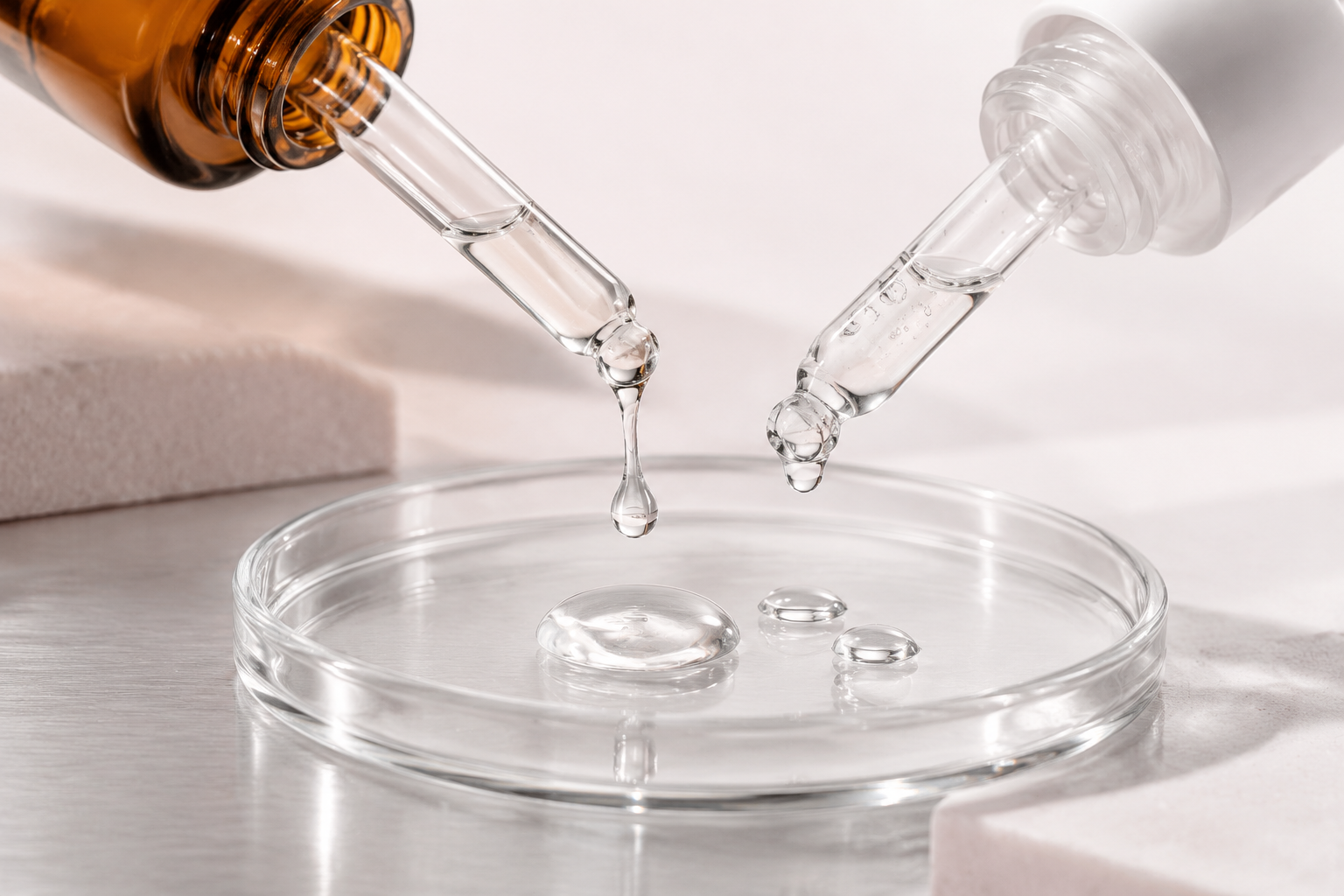
1. Active pH, Solvent Vehicle & Foundation Compatibility Matrix
Single-active minimalist serums achieve low unit cost by stripping complex multi-emulsifier buffering systems. As a result, their solvent vehicle (water, propanediol, squalane, or dimethicone) directly dictates whether makeup applied 10 minutes later stays smooth or rolls into clumps.
| Active Class & Concentration | Nominal pH / Medium | Incompatible Pairings | Pre-Makeup Layering Verdict |
|---|---|---|---|
| Niacinamide 10% + Zinc PCA 1% | pH 5.5 - 6.5 (Aqueous + Pentylene Glycol) | Strong L-AA powders (surface salt foaming) | Use 2 drops max; excess xanthan/carrageenan gum pills under silicone primers |
| Glycolic 7% / Lactic 10% AHA | pH 3.5 - 3.8 (Water + Propanediol) | Copper Peptides (CAIS), Retinoids in same step | PM only; lowers stratum corneum cohesion and increases UV sensitivity |
| Vitamin C 23% Suspension | Anhydrous (Squalane / C12-15 Alkyl Benzoate) | Aqueous niacinamide & peptides immediately after | Gritty micro-crystals disrupt uniform liquid foundation films; reserve for PM |
| Copper Tripeptide-1 (NIOD CAIS / Multi-Peptide) | pH 5.5 - 6.5 (Aqueous) | Direct Acids, L-Ascorbic Acid, Strong Chelators | High makeup compatibility; absorbs cleanly in 3 minutes with zero film residue |
| NIOD Photography Fluid Opacity 12% / 8% | Silicone Dispersion (Dimethicone / Silica) | Heavy petrolatum balms underneath | Hue-correcting nano-prisms scatter red/yellow optics for camera-ready bare skin |
2. Interactive Active & Base Compatibility Check
Select Morning Serum Before Makeup
SERUM CHECK: DOSE-CONTROLLED COMPATIBLE
Apply 2 drops on slightly damp skin and wait 4 minutes before sunscreen. Over-application leaves excess zinc PCA and carrageenan polymer that shears into white pill rolls under high-silicone foundations.
3. LED Photobiomodulation Wavelengths & Fluence Specs
Academic engineering citations referencing Make & Up's historical LED guide evaluate narrow-band red (633 nm) and near-infrared (830 nm) irradiance. Effective home or clinical panels avoid thermal heating while delivering 4 to 10 J/cm2 per session across target chromophores.
Historical DECIEM & LED Citation Preservation
Archive: /the-ordinary/ (2017-2021 Russian & European Beauty Community Hub)
Preserved anchor for community discussions across Beauty Insider, Littleone, SHU, and Foren.Germany covering serum layering, Granactive Retinoid in squalane, Azelaic Acid 10% silicone suspension, and pH conflicts. See also our Russian-language DECIEM summary.
Archive: /black-friday-deciem-deals-2018/ (Knowvember Formulation Index)
Preserved reference documenting DECIEM's annual November "Knowvember" slow-beauty markdown cycle and core baseline product shelf-life recommendations (12M PAO for aqueous peptides, 6M for L-ascorbic acid).
Archive: /how-led-therapy-works/ (Academic Photobiomodulation Citation)
Preserved citation target referenced in engineering literature on facial phototherapy devices (Scilit & KNTU archive). Covers non-thermal 633 nm red and 830 nm near-infrared LED protocols, eye protection shielding, and pigment-safe post-treatment barrier care.
4. Solvent Polarity, Polysorbate Gels & Makeup Pilling
Single-ingredient minimalist serums achieve low retail cost by relying on high-concentration glycols (propanediol, pentylene glycol, ethoxydiglycol) or high-molecular-weight rheology modifiers like xanthan gum and sodium hyaluronate crosspolymers rather than multi-phase microemulsions. While effective for aqueous active delivery, un-rinsed gum films form brittle hydrophilic sheets upon drying. When a wearer subsequently buffs a volatile cyclopentasiloxane foundation or water-in-silicone sunscreen across that dried hydrophilic sheet, mechanical brush shear detaches the water-soluble gum into visible grey-white pill rolls laced with iron oxide pigments.
Laboratory layering trials confirm two reliable mitigations for morning pigment stability. First, shift anhydrous L-ascorbic acid suspensions, heavy squalane retinoids, and thick dimethicone/polysilicone-11 primers like Azelaic Acid Suspension 10% strictly to evening routines unless pairing intentionally with an anhydrous silicone foundation. Second, limit aqueous film-formers like Niacinamide 10% + Zinc 1% to two drops pressed into damp skin, allowing four minutes of evaporation before applying a fluid European UV emulsion, then waiting a full fifteen minutes for acrylate film coalescence before color application.
5. Post-LED Barrier Prep & Non-Thermal Fluence Rules
Photobiomodulation devices operating at 633 nm (red) and 830 nm (near-infrared) require an optically unobstructed stratum corneum to achieve predicted dermal penetration depths of 2.0 to 4.5 millimeters. Even trace residues of iron oxides (CI 77491, CI 77492, CI 77499), titanium dioxide, or zinc oxide attenuate incident irradiance dramatically through specular backscatter and broadband visible absorption, reducing net cellular cytochrome c oxidase photon delivery while warming superficial films.
Perform red and near-infrared LED sessions strictly on freshly cleansed, dry skin before applying antioxidant serums, silicone primers, or UV filters. Immediately following a 10-minute session (typically 4 to 8 J/cm2 optical fluence at 20 to 40 mW/cm2), low-molecular-weight aqueous peptides, panthenol, or squalane absorb evenly without thermal interference, preparing a calm, uniform surface for morning mineral pigment application.
6. Frequently Asked Questions: DECIEM Layering & Shelf Life
Can The Ordinary Niacinamide 10% + Zinc 1% be mixed directly with Vitamin C Suspension 23%?
Direct palm mixing alters surface micro-pH and aggregates suspended ascorbic acid crystals inside the xanthan gum network, producing uneven texture and flushing irritation on reactive skin. Separate L-ascorbic acid suspensions into evening routines and apply thin aqueous niacinamide in the morning with a four-minute cure interval before sunscreen.
Why did The Ordinary Serum Foundation feel dry over retinoid-treated cheeks despite its fluid texture?
Serum Foundation relies on volatile dimethicone and coconut alkanes that flash off within minutes after application, leaving thin coated pigments directly against the stratum corneum. When corneocyte shedding increases under tretinoin or Granactive Retinoid, priming first with squalane or barrier ceramides prevents pigment clinging around micro-flakes.
Do NIOD copper peptides degrade mineral iron oxide foundations?
No. Copper tripeptide-1 complexes are buffered near pH 5.5 to 6.5 and do not destabilize iron oxide or ultramarine pigments. Allow three minutes for aqueous absorption before sunscreen to keep total surface moisture balanced. Avoid layering strong direct alpha-hydroxy acids or unbuffered L-ascorbic acid over copper peptides within the same routine window so peptide chelation stays intact.